
How we know it actually works.
Most plant-based bug sprays make big promises and quietly underperform in independent testing. We took the opposite approach: sixteen years of laboratory bioassays, electron-microscope evidence, and real-world field trials — much of it run by an independent, Board Certified Entomologist. Here is what they found.
It doesn’t poison bugs. It dries them out.
Conventional sprays are nerve poisons — and bed bugs famously evolve resistance to them (over 80% of U.S. populations already survive pyrethroids). Our active protein complex, Residulen— built from soybean oil — works by a completely different route: it strips away the waxy outer layer that seals moisture inside an insect’s body.
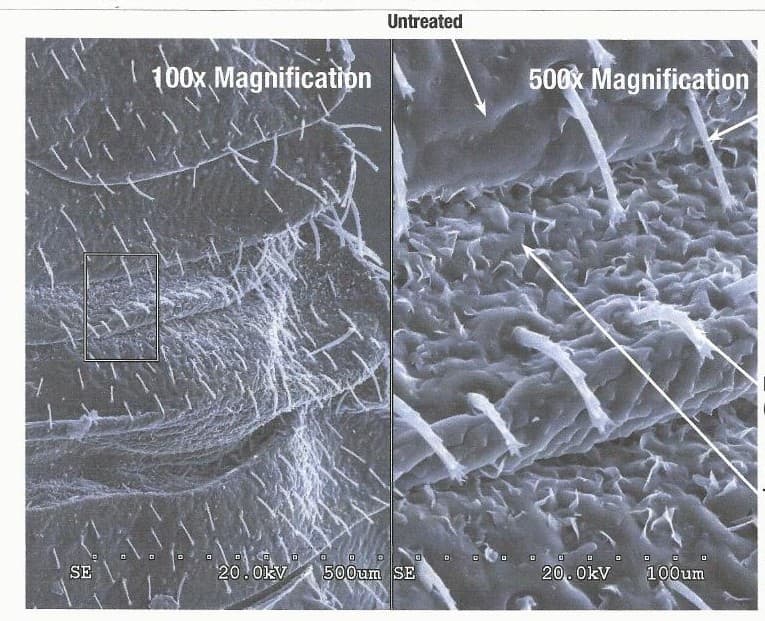
Once that layer is gone, the insect simply dehydrates. Because the target is a physical structure rather than a nerve receptor, researchers argue it is unlikely to select for the resistance seen with conventional chemistry. You can see the damage under an electron microscope — a smooth, healthy cuticle before treatment, and a cracked, collapsed one after.
The protein coats the shell
Residulen spreads across the insect's waxy cuticle on contact.
The wax layer breaks down
The protective epicuticular wax is emulsified and compromised.
Moisture escapes
Body fluids evaporate and the insect can't survive the loss.
Kill speed dropped from minutes to seconds.
We ran direct-spray bioassays against bed bugs across four generations of the formula. With each iteration the concentrate was refined, and time to 100% mortality fell from ten minutes to single-digit seconds — with untreated control bugs surviving throughout.
The Gen 3 formula killed adult bed bugs within 17 seconds and nymphs within 3 seconds; the current Gen 4 formula kills early-instar bed bugs in 5–8 seconds. In the same bioassay series, house flies fell in under 2 minutes, American cockroaches in 5–10 minutes, and ants in ~5 minutes. Source: independent AAES / ASL direct-contact bioassay record.
Proven in the lab, the chamber, and the field.
Kills fast on contact
In repeated laboratory bioassays, VA88 killed bed bugs on contact, near instantly, on direct spray. Exposed adults and nymphs reached 100% mortality; untreated controls survived.
Keeps working for a year
A controlled chamber study confirmed the dried residue still killed bed bugs at 30, 60 and 90 days — 26 of 28 checkpoints affirmed (92.9%). In the field, residue killed re-introduced bugs more than 12 months after a single application.
Proven in the real world
A four-story hotel cleared its bed bugs and a historic state museum cleared a two-year carpet-beetle infestation — each after a single treatment, with no insects found in the final months of monitoring.
The residue is still lethal months later.
A structured containment-chamber study evaluated residual mortality of bed bugs on treated carpet at 1 hour and at 30, 60 and 90 days after a single application. The pass criterion was 100% mortality within the product’s 6–8 hour window. Across seven chambers and four time points, 26 of 28 evaluations were affirmed.
Two isolated chambers missed the full criterion at the 30- and 60-day points — consistent with residual reservoir depletion where less product had been deposited. The study concluded residual efficacy is directly related to the amount of residue left on the surface, which is why applying to label directions matters. A separate 13-month field challenge re-introduced live bed bugs onto carpet treated more than a year earlier: all nymphs were dead by hour 4 and all adults by hour 13.
A working hotel put it to the test.
Twenty guest rooms — eleven with active bed-bug infestations, nine treated preventively — were treated once, then monitored for a full year with traps, physical inspection, and trained bed-bug-dog inspection. No room was ever re-treated.
Not your average plant-based spray.
Comparison reflects independent testing of common 25(b) consumer bed-bug products (Rutgers University / Pest Control Technology, 2013), in which most products underperformed against bed bugs.
References
- [1]American Academy of Entomological Sciences (AAES). Evaluation of ASL Product REF Formula 020909.1 — ingredient identity, GRAS/25(b) confirmation, multi-species direct-spray mortality. Feb 9, 2009.
- [2]AAES. Residual Tests with Bed Bugs — Report VX8807032010. Jul 5–23, 2010. Residual kill-curve on treated substrate.
- [3]AAES. Deposition Measurements on Fabric Samples — Report VX8810062010. Nov 6, 2010. Dose/pass-rate dependence of residual load.
- [4]Applied Science Labs (M. Yoo, Ph.D.). Evaluation of VA88 as a Residual Against Bed Bugs — Project 0308164. 2016. 1-hour / 30 / 60 / 90-day chamber study.
- [5]AAES. Direct Spray Method on Bed Bugs — Project 03032015-15. Mar 3, 2015. Modified formula: mortality within 5–8 seconds.
- [6]AAES. Field Evaluation — Projects APS-110911-1032 (Nov 2011) & APS-121411-1214 (Jan 2012). Hotel & museum; 13-month residual challenge.
- [7]Applied Science Labs. Scanning Electron Microscope Evidence — Mode of Kill (2015). Cuticular emulsification / dehydration imagery.
- [8]Brown, J.K., et al. “A year-long efficacy study on bed bugs with a new 25(b) product.” Pest Control Technology, December 2012.
VA88 is an EPA FIFRA Section 25(b) minimum-risk product, made only from ingredients on the EPA’s minimum-risk list and exempt from EPA registration. Exemption from registration is not an EPA endorsement or approval.
The studies summarized here were conducted voluntarily and were not formal GLP-certified trials. Field results describe insects found or not found at live sites rather than a percentage of an unknown wild population. Two of twenty-eight checkpoints in the 90-day residual study did not meet the full criterion. We report all of this because credible testing means showing the whole picture. Results depend on applying the product according to label directions.
Kills bed bugs in seconds. Keeps working for a year.
VA88 kills on contact and protects for up to 12 months — EPA 25(b) exempt, zero neurotoxins.